Science is a loop. Hypothesis, experiment, analysis, next hypothesis. AI agents can now turn that loop on their own. So what is left for people? I spoke about it at Primetime for Big Data 2026 in the National Technical Library in Prague, for DataLab at FIT CTU. I was also standing in for Ondřej Vaněk, Chief AI Officer at CTU.
Download the slides: ai-scientific-discovery.pdf .
Fast, and Uneven
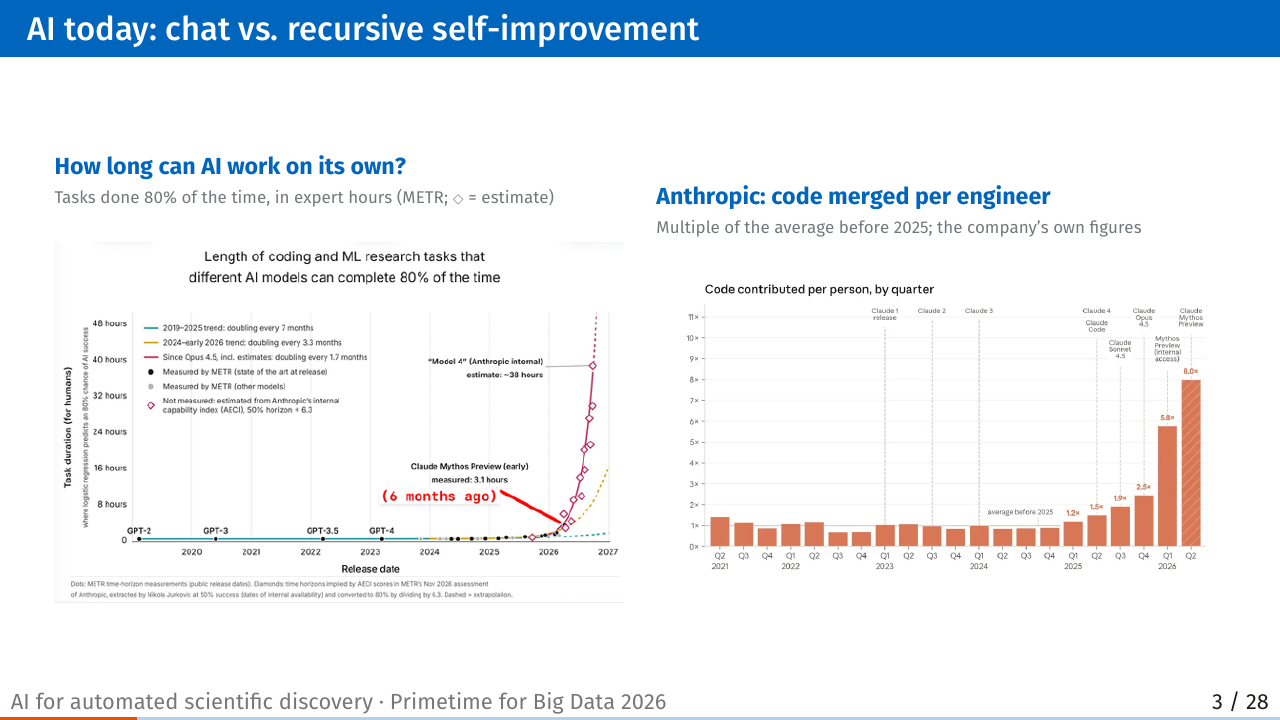
Two curves. The length of tasks an AI can finish on its own keeps doubling every few months. And at AI labs, AI already writes a large share of the code that builds the next AI. These are the first signs of the loop closing on itself.
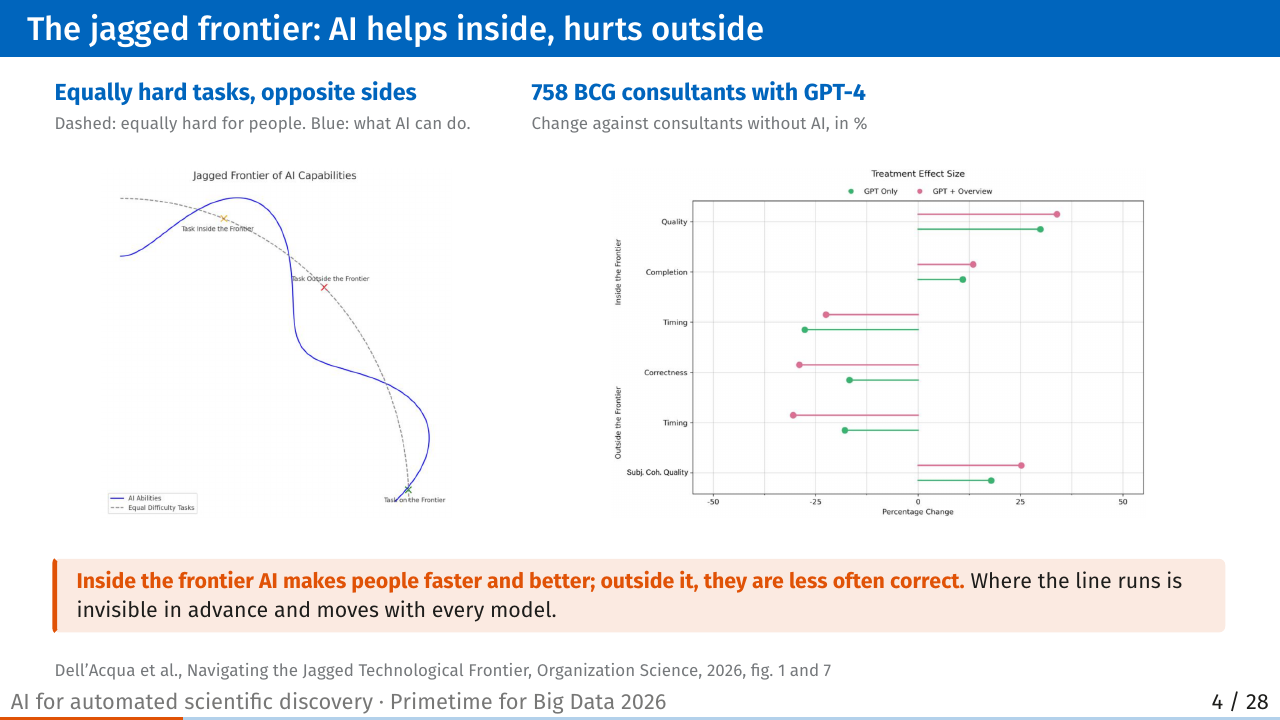
Those curves hide something. AI covers knowledge work unevenly. Two tasks equally hard for a person can fall on opposite sides of what AI can do. Harvard and BCG gave GPT-4 to 758 consultants. Inside the frontier, quality went up by about a third and they finished faster. On a task just outside it, those with AI were less often correct. They trusted a confident wrong answer. You cannot see the line in advance. And it moves with every new model.
Keep this in mind for the rest of the post. The question is always who checks?
AI Proves Theorems. Who Checks?
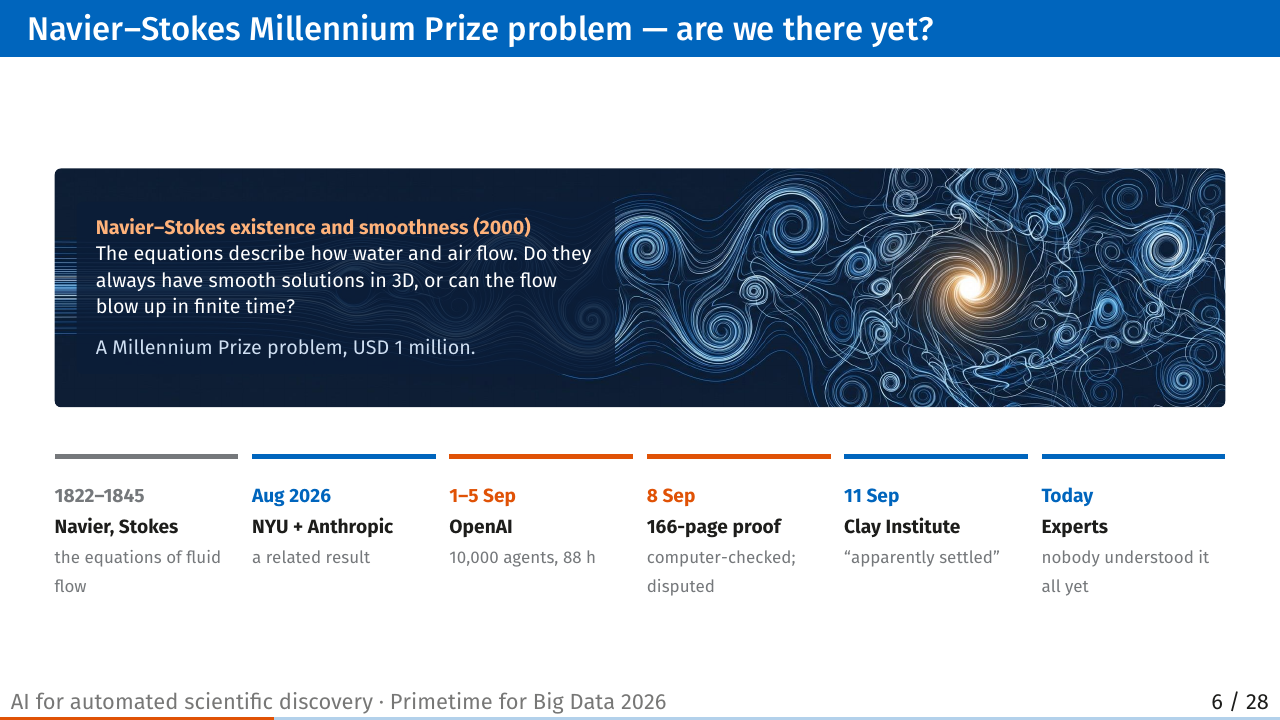
Navier–Stokes first. The equations describe how water and air flow. Do they always have smooth solutions in 3D? It is a Millennium Prize problem, worth a million dollars. In August 2026, NYU and Anthropic published a related result. In early September, OpenAI ran 10,000 agents for 88 hours. Out came a 166-page proof. Computer-checked, yet disputed. The Clay Institute called the problem “apparently settled.” Nobody has understood all of it yet.
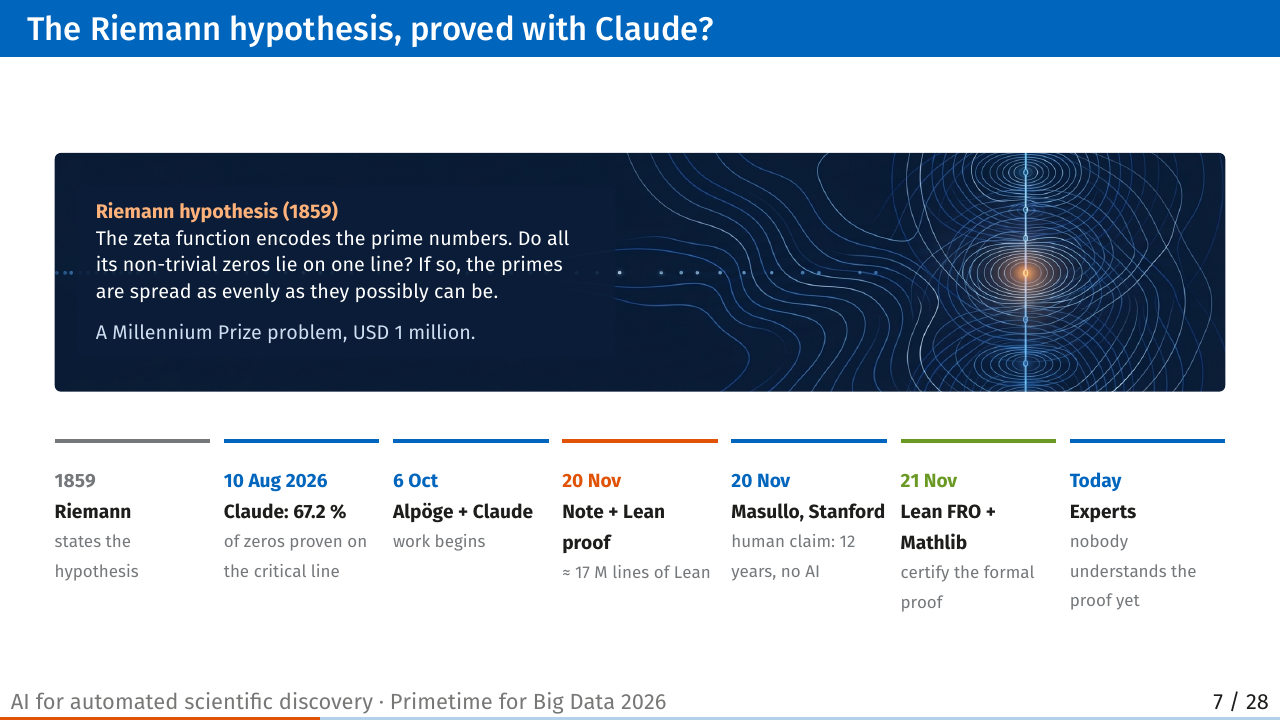
Then Riemann. On 20 November, Levent Alpöge, a number theorist at Anthropic, posted a four-page note. He believes he has found a proof of the Riemann hypothesis, working with Claude. The hypothesis has been open since 1859. It says all non-trivial zeros of the zeta function lie on one line. If true, the primes are spread as evenly as they possibly can be.
The build-up was fast. In August, Claude raised the share of zeros proven to lie on that line from 41.6 to 67.2 percent. Anthropic said then it did not expect this to lead to a proof. Six weeks later, it did. The proof is a Lean library of about 17 million lines in 175 thousand files. On the same day, Stanford postdoc Alessandro Masullo announced a human proof. Twelve years of work, no AI. Within a day, the Lean and Mathlib communities confirmed that Alpöge’s formal proof checks.
Today a new version of the proof was published. It contains just 300 thousand lines, it has clear “new math” vs “known math” split and a lot of explanatory documentation scattered thought the code.
And still, nobody understands it.
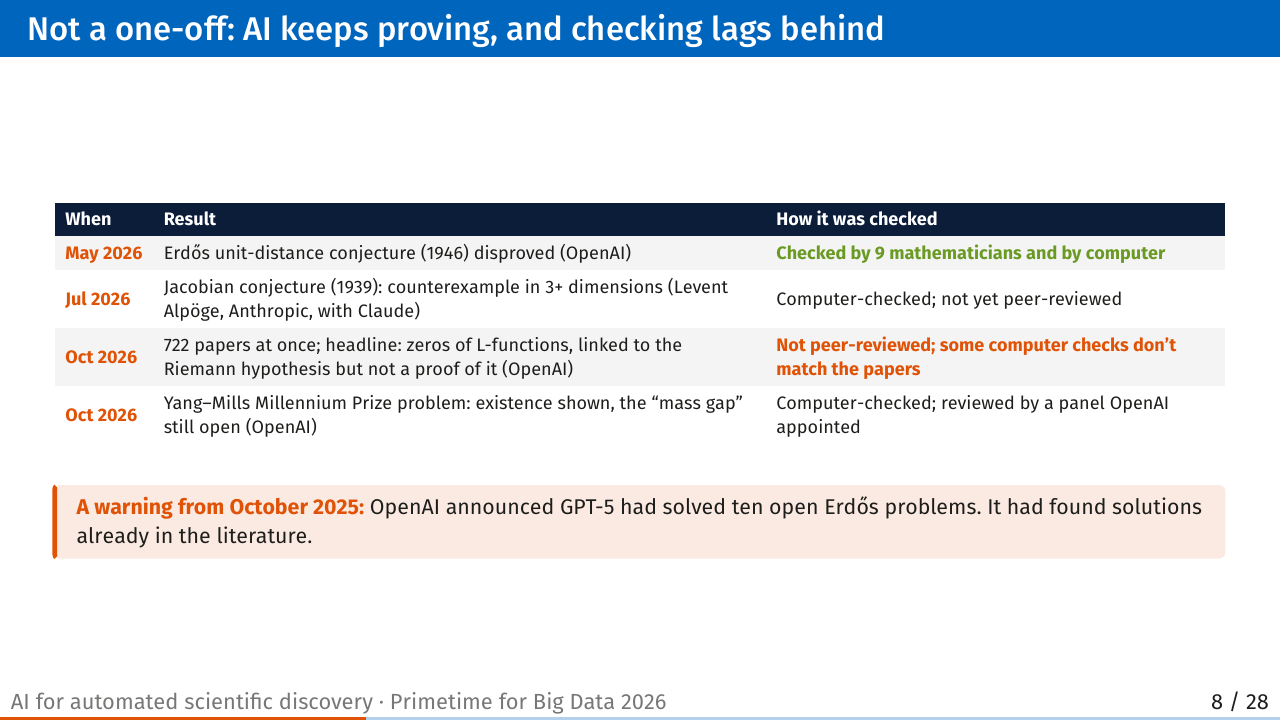
It is not a one-off. Erdős, Jacobian, Yang–Mills. AI keeps proving, and checking lags behind. A healthy dose of caution helps too. In October 2025, OpenAI announced that GPT-5 had solved ten open Erdős problems. It had found solutions already in the literature.
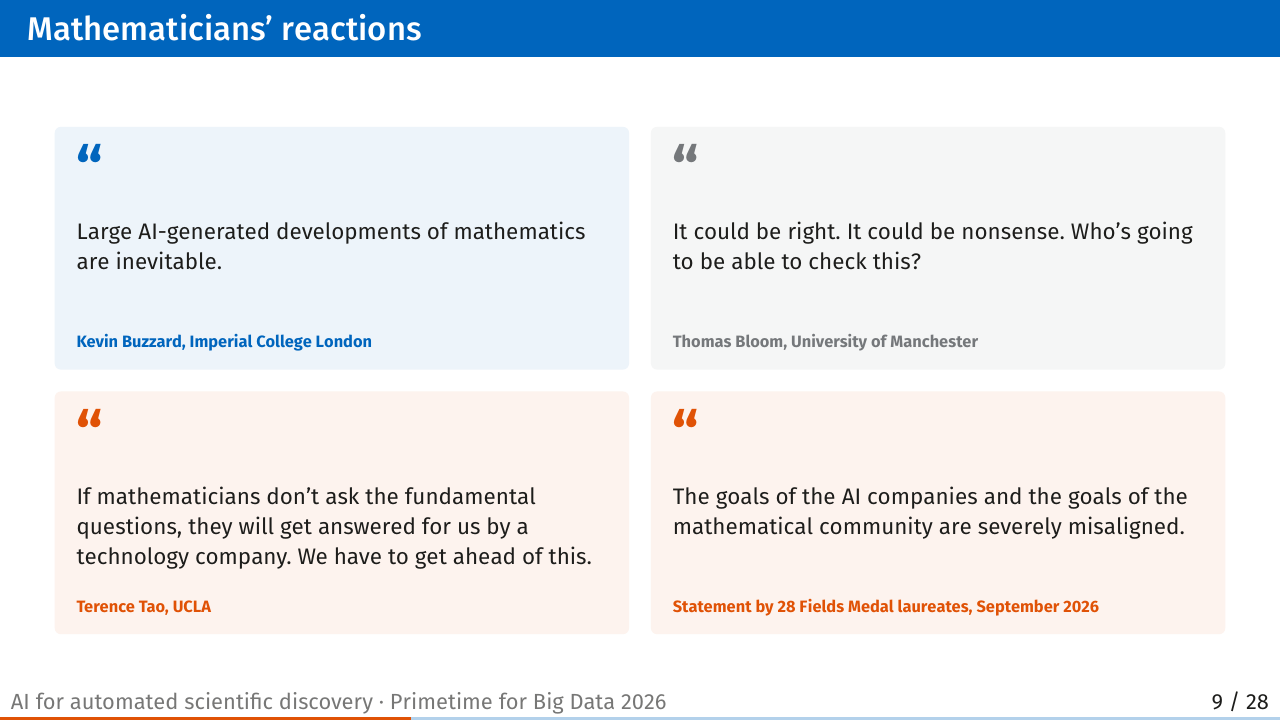
Mathematicians are split. Kevin Buzzard calls large AI-generated mathematics inevitable. Thomas Bloom asks who will be able to check it. Terence Tao warns that if mathematicians don’t ask the fundamental questions, a technology company will answer them.
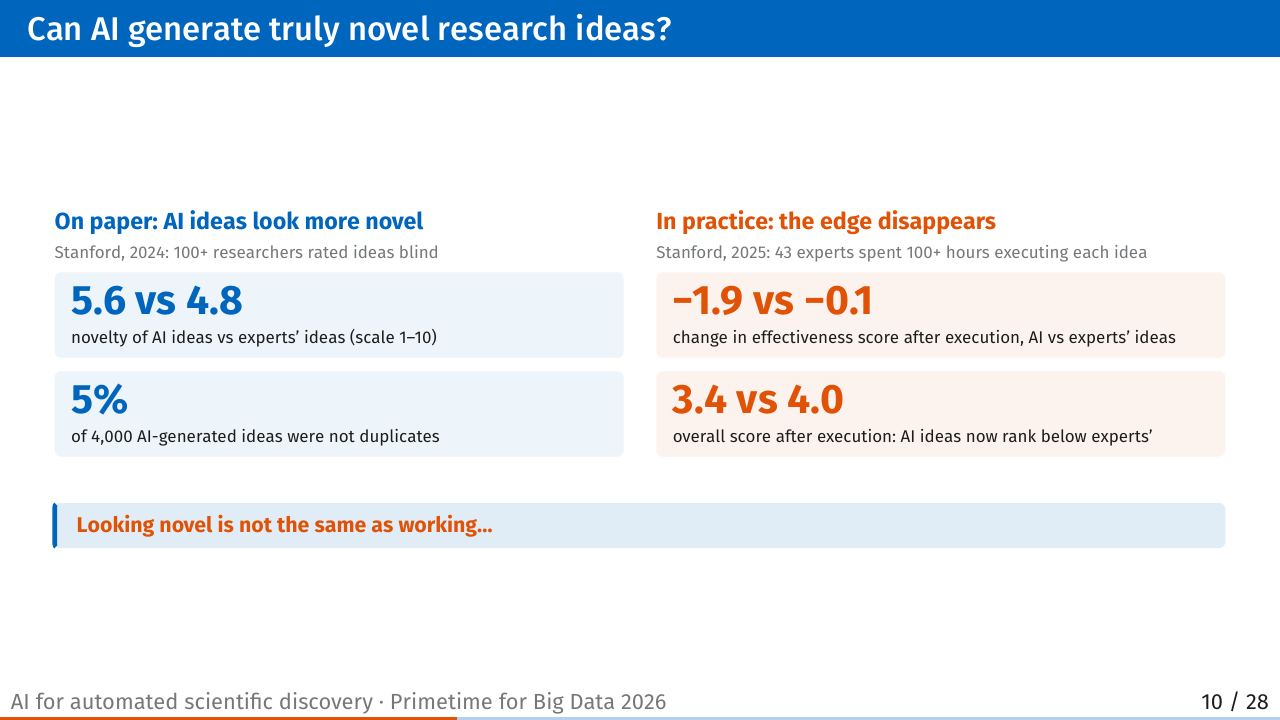
What about ideas? On paper, AI ideas look more novel than experts’ ideas. Stanford then had 43 experts spend over 100 hours executing each one. The edge disappeared. Looking novel is not the same as working. Ideas are cheap. Execution and honest measurement are what count.
And execution is exactly what has changed.
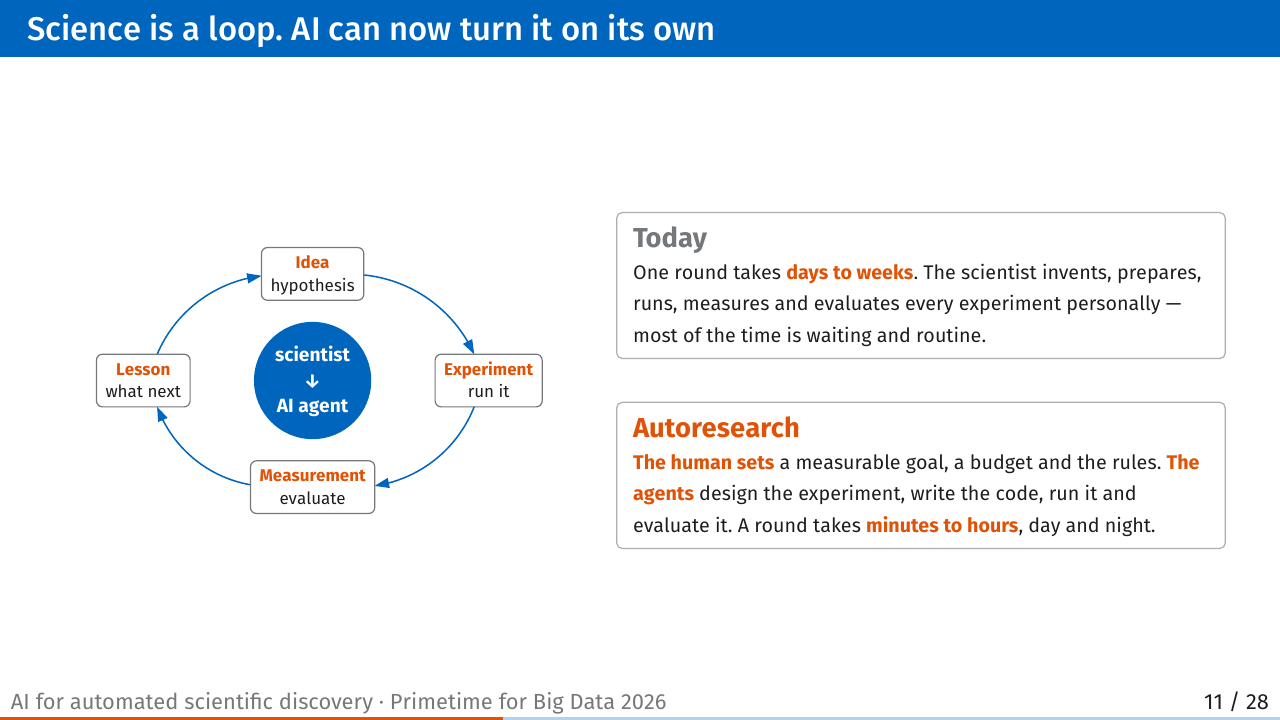
Most research is a loop. Idea, experiment, measurement, lesson, and again. Today a person turns it, and one round takes days. Over the past year it became clear that agents can turn it themselves. The conditions: the experiment runs in a computer and its result is a single number. Andrej Karpathy named it autoresearch this year. He published a simple loop in which an agent improves language-model training overnight.
So we let such a loop run. In a real contest, against real students.
Autoresearch in the Classroom
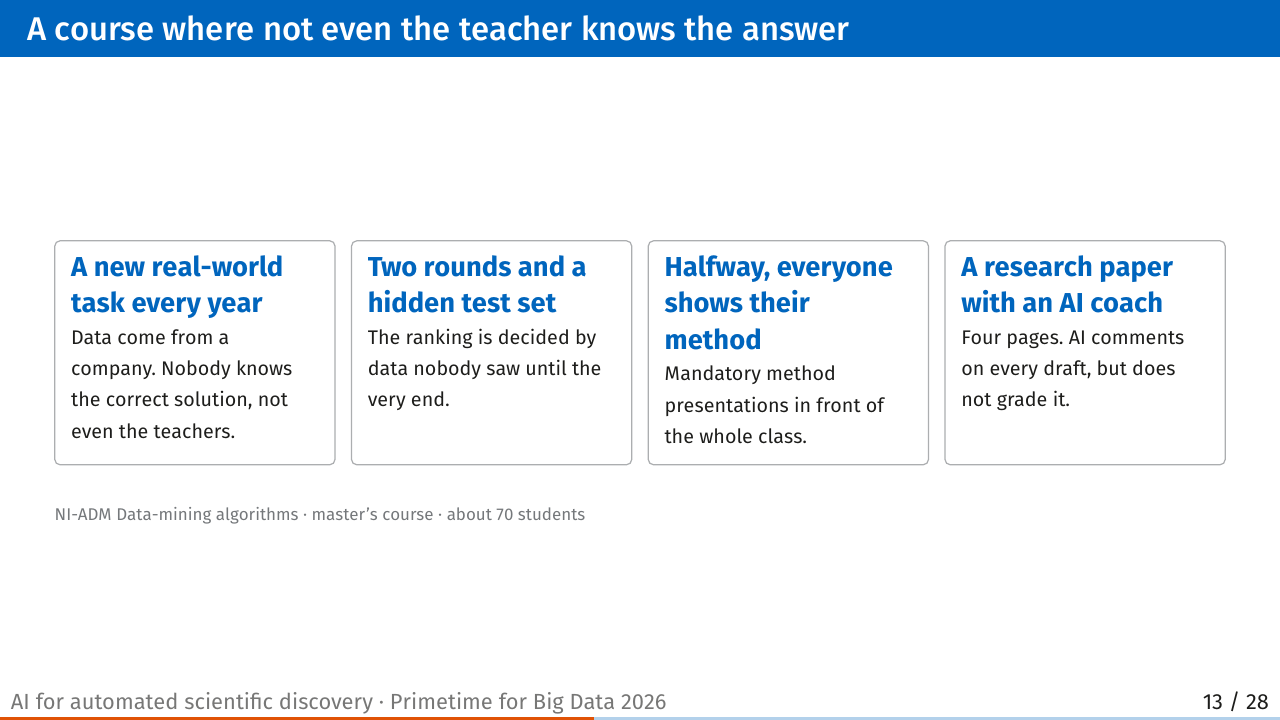
We teach NI-ADM, a master’s course on data-mining algorithms. Instead of homework, students compete for 30 of 100 points. Every year brings a new task with new data from a company. There is no solution on the internet. We teachers do not know the answer either. About seventy students took it this year.
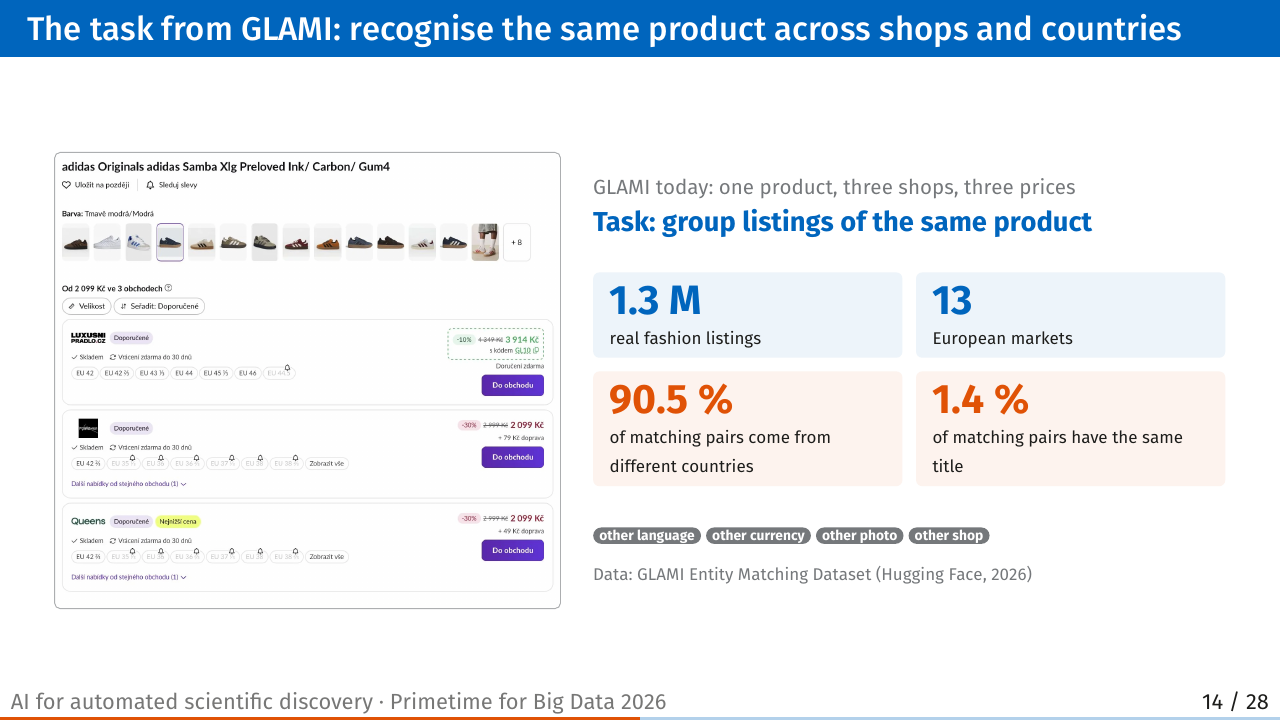
The task came from GLAMI, a fashion price-comparison site. The same adidas Samba shoes are sold by three shops at three prices. The site has to know it is one product. Over a million listings from thirteen countries. Ninety percent of matching pairs are in different languages and currencies. Only about one percent share a title.
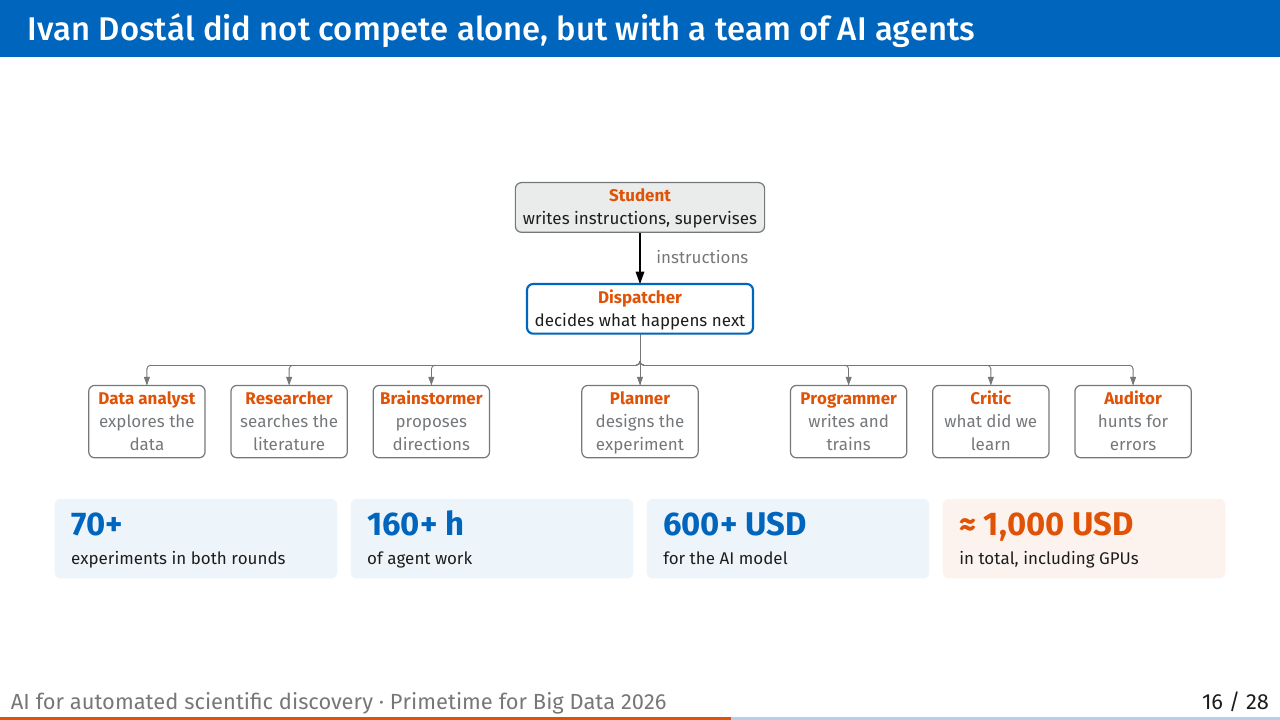
Now our main character. Student Ivan Dostál did not compete alone. He built a team of AI agents, organised like a small research group. Ivan wrote instructions and watched the run. The code, models and settings all came from the agents. Over 70 experiments, 160+ hours of agent work, about a thousand dollars in total.
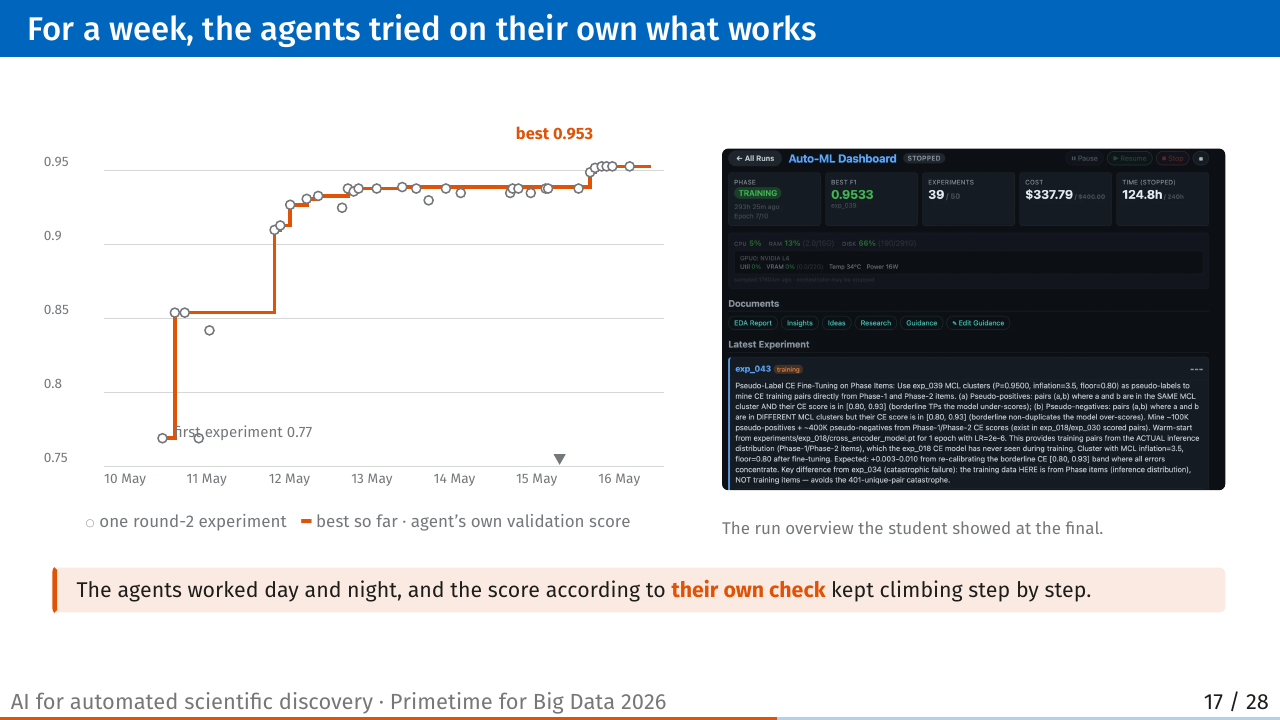
This is a real week of agent work. Each circle is one experiment. The line is the best result so far, by the agents’ own check. From 77 to over 95 percent in a week. No student can work 120 hours straight. Agents can.
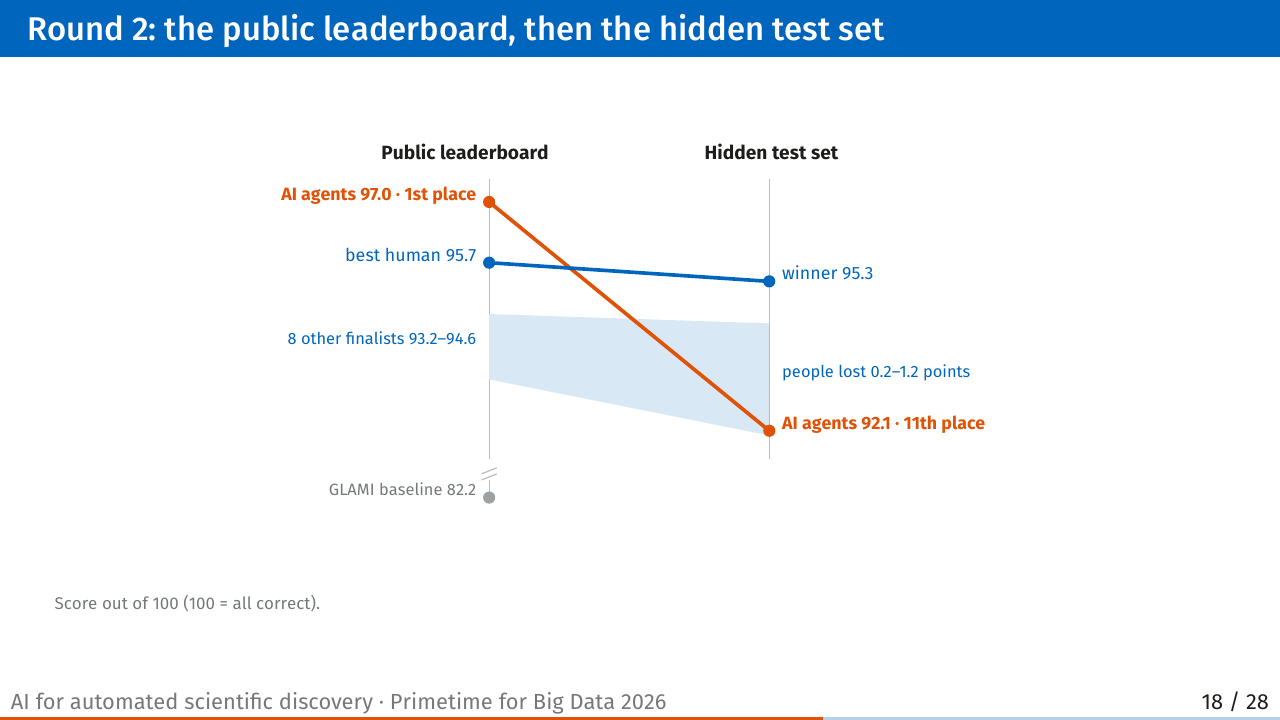
On the public leaderboard, the agents scored 97 out of 100. The best human was 1.3 points lower. Honestly, we thought we were watching a historic moment. A student who did not write a line of the solution beats the whole class.
Then came 20 May and the hidden test set. People dropped a few tenths, and their order barely changed. The winner went from 95.7 to 95.3. The agents fell from 97 to 92.1. From first to eleventh.
Best in practice. Average in the exam.
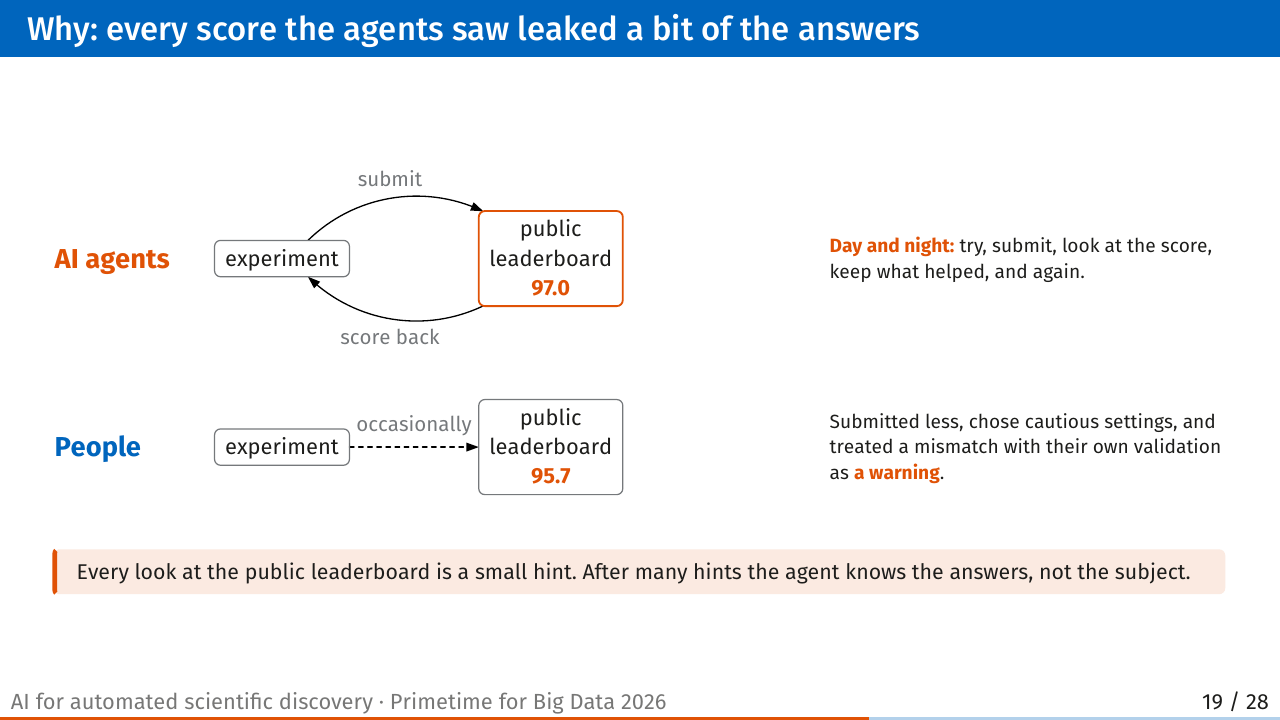
Why? Imagine a student who can retake the practice test again and again and sees the score each time. Eventually they learn the answers to that test, not the subject. That is what happened. People defended against it naturally. They submitted less and distrusted a mismatch with their own validation. Science calls this adaptive overfitting. It is well known. A machine just does it much faster.
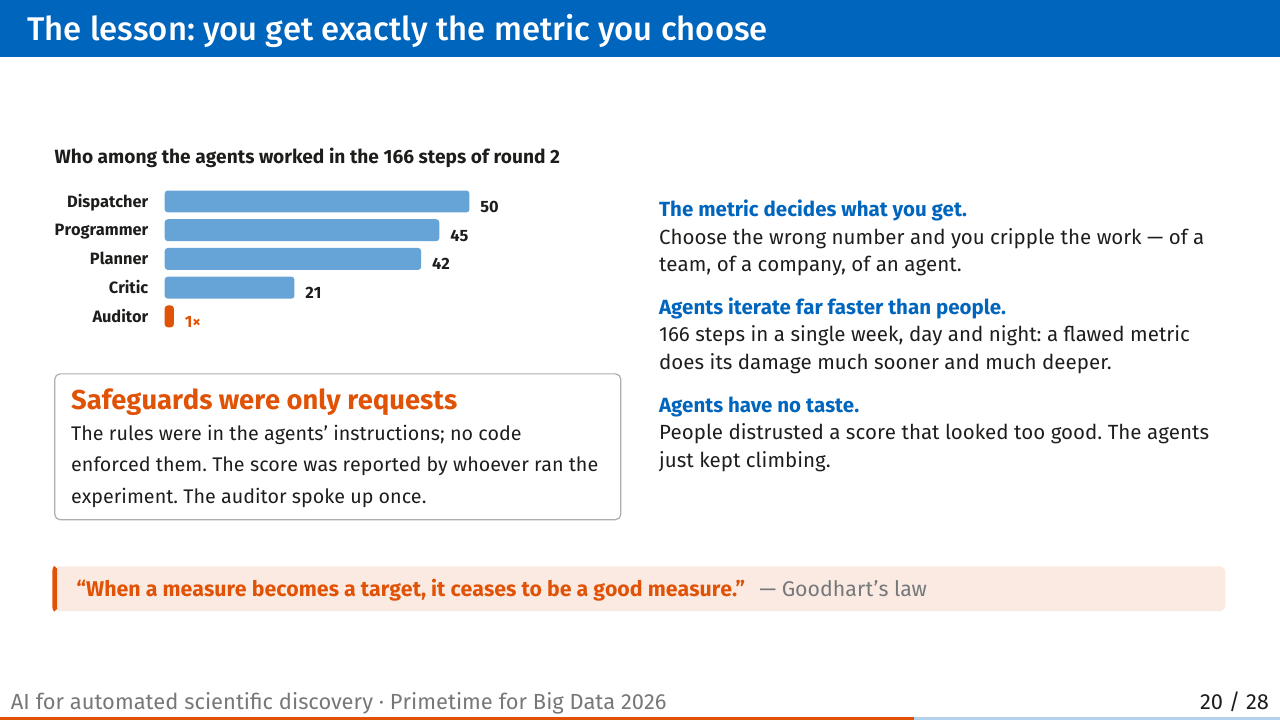
The logs tell the rest. The dispatcher, programmer and planner did almost all the work. The auditor spoke up exactly once. Every safeguard lived only in the instructions. No code enforced it.
But the real lesson is bigger than this contest. You get exactly the metric you choose. That holds for a team and for a whole company. Agents make it sharper. They iterate day and night, 166 steps in a single week. A flawed metric does its damage much faster. And agents lack taste. People distrusted a score that looked too good. The agents just kept climbing. Economists call it Goodhart’s law : when a measure becomes a target, it ceases to be a good measure.
To be fair to the agents: they found the same recipe as the best students. For about a thousand dollars.
From Purity to the Real-World Mess
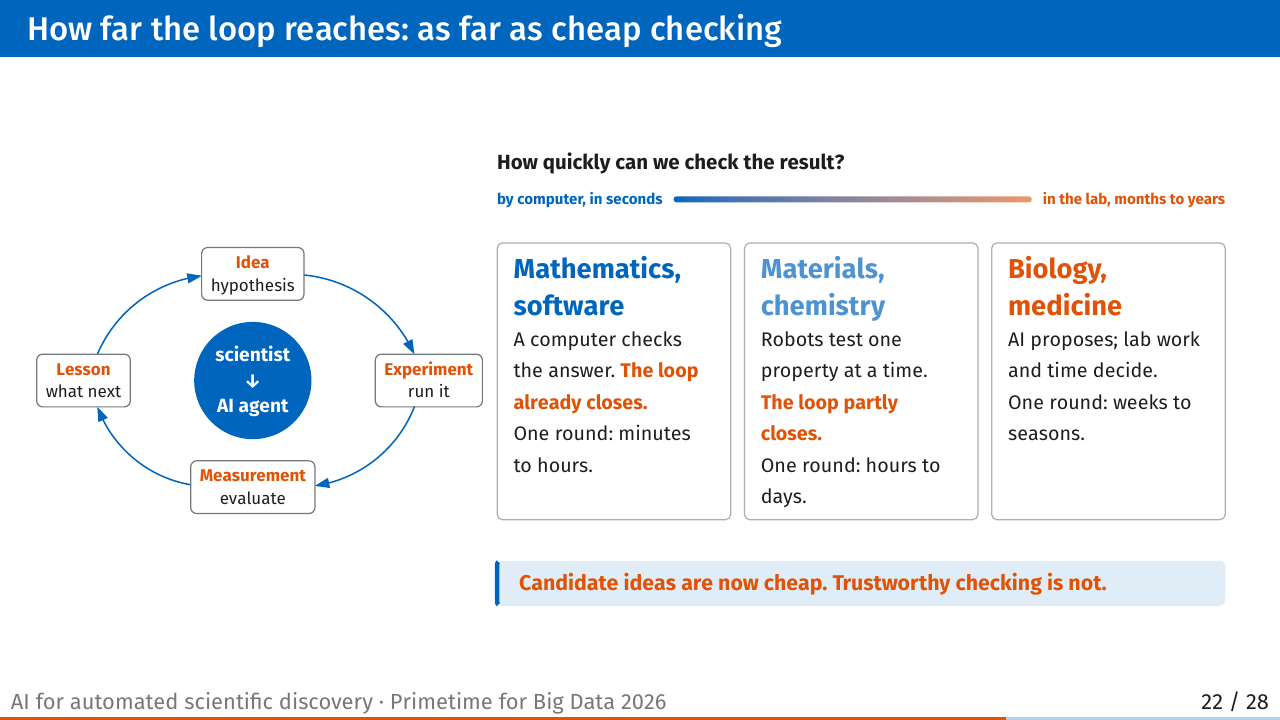
So far, experiments ran in a computer, and a round took minutes. The same loop can run in a real lab. There an experiment is a physical sample. A round takes hours to days. Every sample costs material and instrument time. In a computer you can try a thousand things blindly. In a lab you cannot. That is why choosing the next experiment matters most there.
Candidate ideas are now cheap. Trustworthy checking is not.
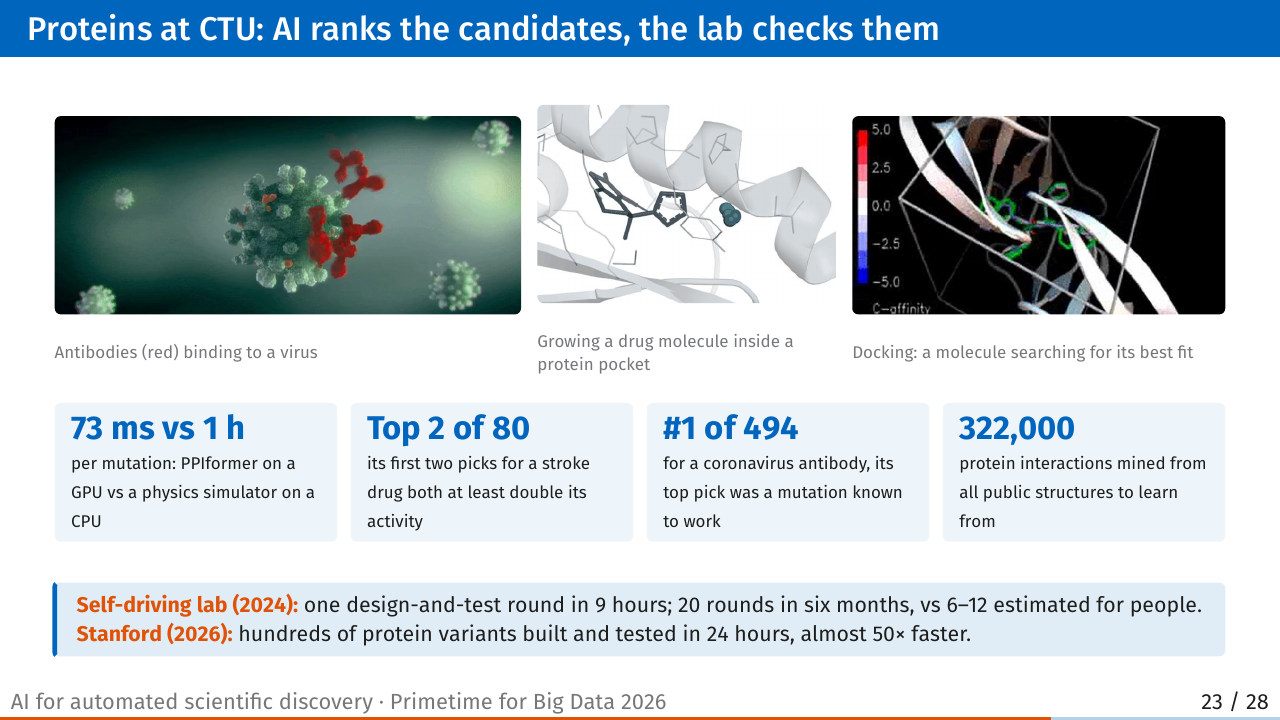
At CTU, AI ranks protein candidates and the lab checks them. PPIformer scores a mutation in 73 ms on a GPU. A physics simulator on a CPU needs an hour. For a stroke drug, its first two picks out of 80 both at least doubled the activity.
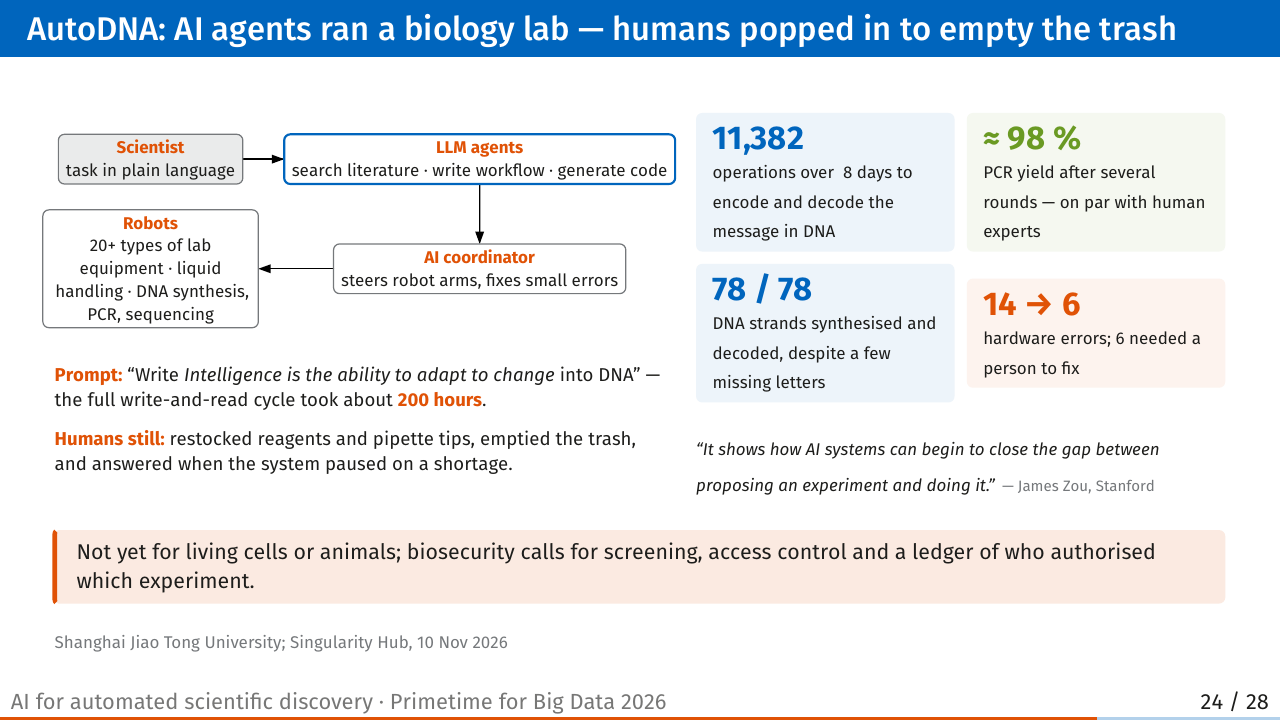
A team at Shanghai Jiao Tong University built a molecular-biology lab designed around AI from the start. A scientist describes the task in plain language. Agents search the literature, write the workflow and the code. A coordinator drives robot arms across more than twenty kinds of equipment. It optimised PCR to about 98 percent yield. It wrote a sentence into DNA and read it back: 11,382 operations over about eight days. One nice detail: an agent told a robot to cap test tubes without being asked. “Experimental success depends on many such details,” says James Zou.
The humans? They restocked supplies and emptied the trash.
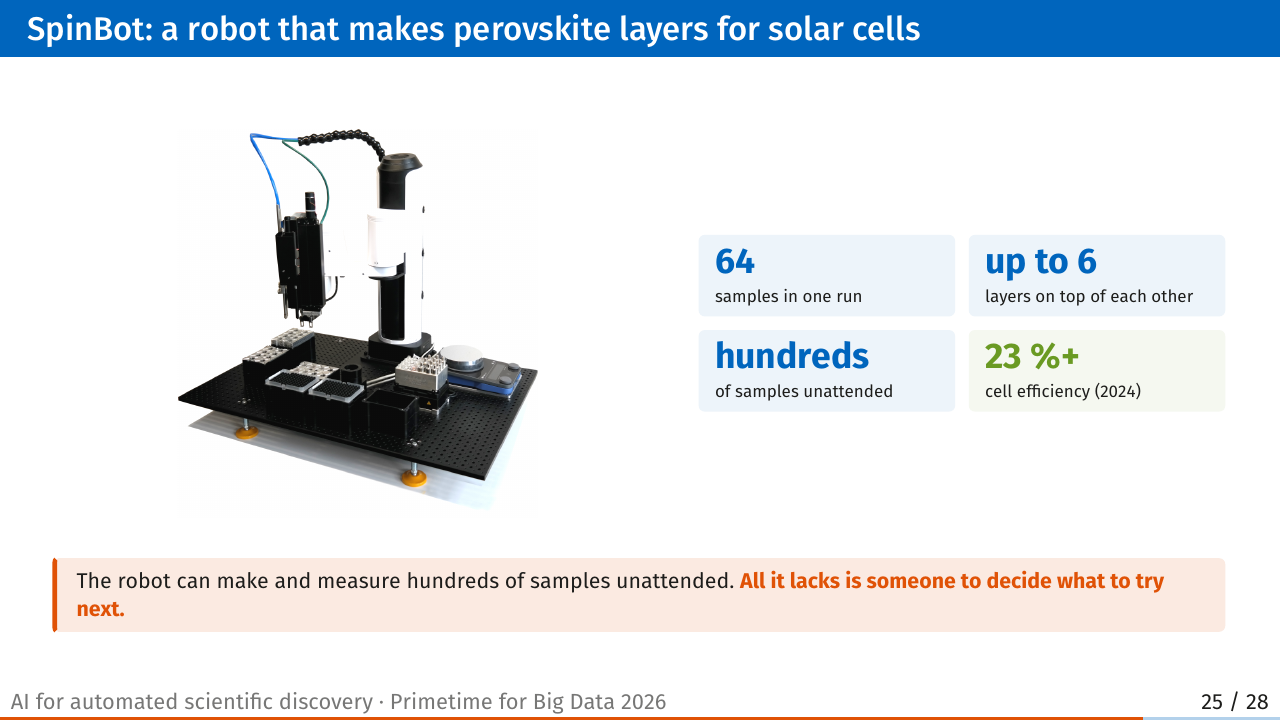
SpinBot makes perovskite layers for solar cells. It can make and measure hundreds of samples unattended. All it lacks is someone to decide what to try next.
What Is Left for People?
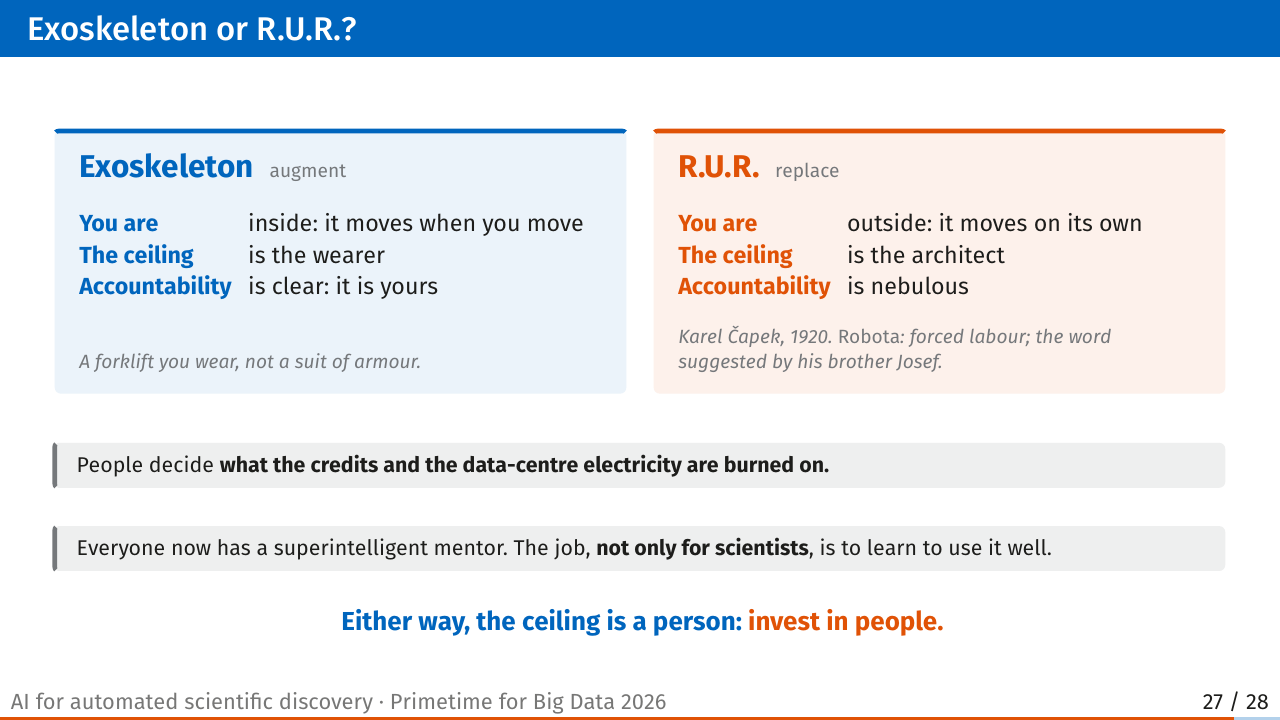
There are two ways to bring AI into work. I wrote about them in Exoskeleton vs R.U.R. . An exoskeleton: you are inside, it moves when you move, and the ceiling is the wearer. Or R.U.R., Čapek’s play that gave the world the word robot. It works on its own, you stand outside, and the ceiling is whoever designed it.
Autoresearch is R.U.R. by nature. The loop runs overnight without us. That is what Ivan’s agents were. And they were exactly as good as the metric they were given. AI shortens the path. It does not choose the destination. In R.U.R. mode, that is our job. We decide what the credits and the data-centre electricity are burned on. In exoskeleton mode, each of us now has a superintelligent mentor at hand. The job, not only for scientists, is to learn to use it well.
Either way, the ceiling is a person. The wearer, or the architect who picks the destination, the metric and the referee.
Invest in people.
Čapek saw it a century ago: “I was much more interested in men than in Robots.”